When I was younger, my Dad would help me with difficult and complex math problems. Almost invariably, he would start out by saying “well, let’s draw a picture.” Then, piece by piece, we would translate the long word problem into a diagram or plot it out on an x/y coordinate. Soon enough, the visual representation of what had been a complex, boggling question helped me see what was there and where to go with the given data.
In life, I see the value in taking the time to understand each peice of a situation, even (perhaps, especially) the parts that don’t seem to make sense or come easily. Instead of “skimming the problem” and deciding that there are easier problems to work on, why not translate it into simpler terms? Instead of being overwhelmed, how about we start with what we do know? What variables are we looking at? What are we trying to solve for? “Let’s draw a picture.”
As we plot each point and connect the dots, we construct a tangible representation of how we are feeling or a situation we are faced with. Perhaps once we are able to see what we have been shoving to the side due to fear, apprehension or pure negligence, we can approach the problem with more certainty.
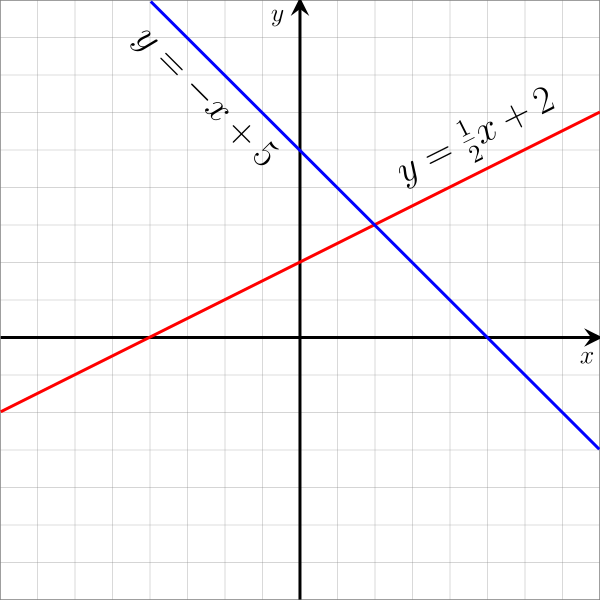
Now let’s suppose that we each have an equation for each of our lives. The structure and inputs of the equation can be constructed and produced by factors such as genetics, past choices, subconcious influences and so on. If the points on the line got there by some action of our own (or rather, because of our equation) surely we have the option of altering the equation to our favor? Take the image below for example. On the left in blue we see a line that is in standard y=mx+b form where m(-1) determines the slope and b(5) determines where it crosses the y-axis. As you can see by the line on the right whose slope is 1/2 and y-intercept is 2, just by changing what these variables slightly alters the line’s direction and appearance entirely. What if we try to isolate what is causing our downward, negative slope?
Of course, our lives are probably much more accurately represented by a line much more complex than a simple linear equation, but it is interesting to begin there just for starters.
The essence of mathematics is not to make simple things complicated, but to make
complicated things simple. ~S. Gudder
- Example of Linear Equations


